Chalk Rivers of England - Wild ID Guide
Chalk Rivers of England - Wild ID Guide
Couldn't load pickup availability
The Wild ID Chalk Rivers of England guide is an identification guide to the insects, molluscs, mammals, fish and plants of this special habitat.
- Identification guide to 40 species
- Practical for use outdoors: lightweight, rucksack-sized, splash-proof
The guide illustrates 40 species which are characteristic of chalk rivers. Companion text that explores how these unique rivers form, what makes them special and the challenges they face today.
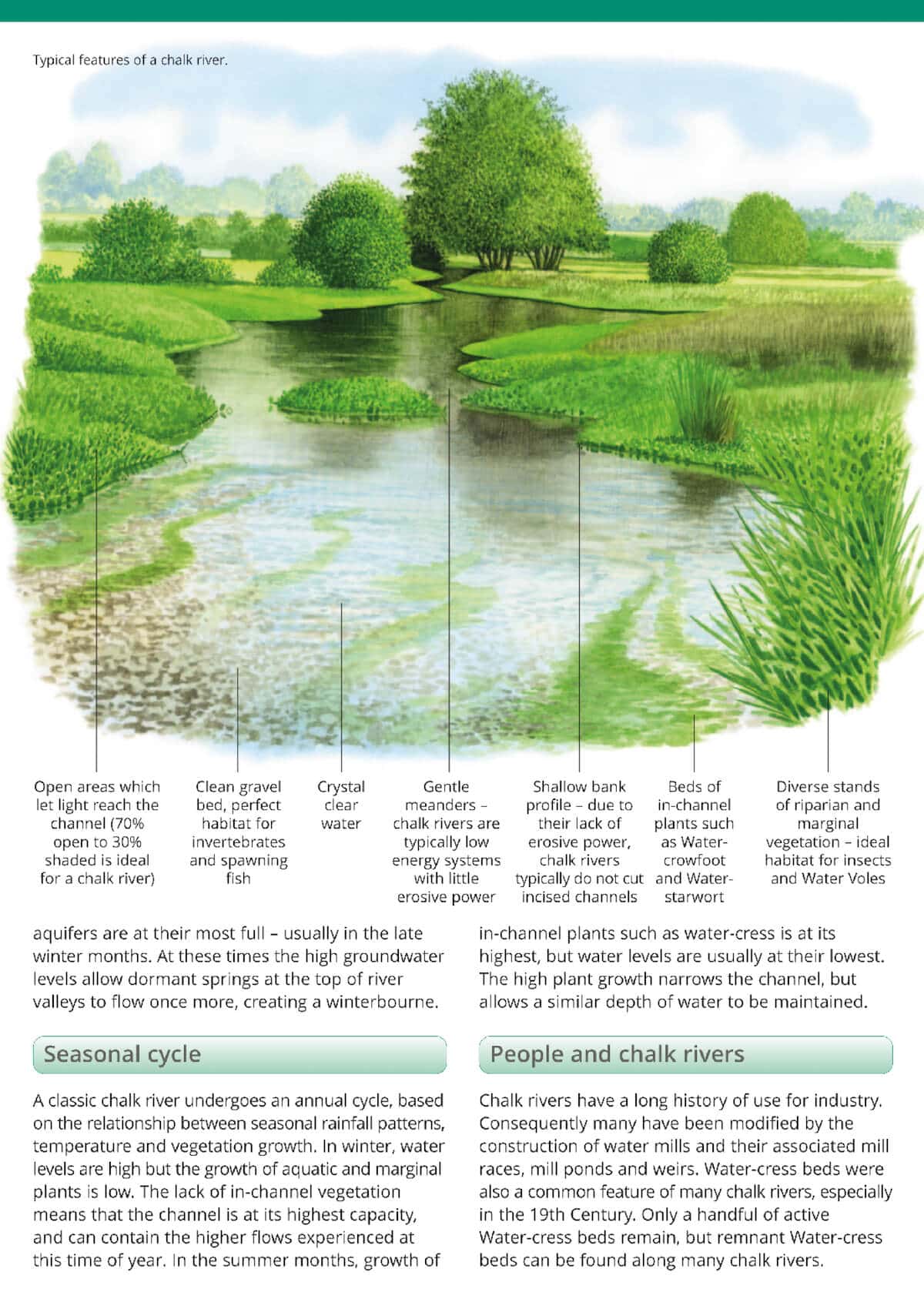
If you are used to seeing muddy streams and rivers, your first sight of a chalk stream will be an unforgettable experience. With crystal clear water flowing gently over a clean gravel bed, a chalk river is a beautiful and diverse ecosystem. They are globally rare: with fewer than 200 chalk rivers in the world. Most of these are in southern England, with the remainder in northern France.
Chalk is porous, making it extremely permeable to water. Rain soaks into the chalk, which acts as a groundwater reservoir, supplying the springs that flow into the chalk river. The unique conditions within a chalk river system result from the properties of this groundwater. Because it has been filtered through chalk, it is pure, clear, mineral-rich and alkaline.
A classic chalk river is influenced relatively little by overland low and runoff. Instead 80% or more of the flow comes from groundwater, water temperature fairly constant. Many chalk river systems have ‘winterbourne’ sections in their upper reaches. These winterbournes usually only flow in late winter, when groundwater levels are highest.
Field Studies Council worked with Herts and Middlesex Wildlife Trust to produce the Chalk rivers guide.
These popular wildlife field guides measure 24.5 cm x 17.5 cm and are extremely lightweight so are the perfect identification aid for popping in your bag when heading outside. All wildlife identification guides are laminated, so are shower-proof and wipe-clean for use outside.